Utah’s winters suck. Temperatures well below freezing and blizzards that make driving terrifying are all part of the package. But, as we Utahans recently discovered, not having a winter sucks even more than suffering through one. I am referring to our last encounter with those months that should have had us cursing Mother Nature’s frigidity. Instead, pleasantness was present and snow was absent. It was bizarre and distressing and for snowboarding it was catastrophic. And yet…
When reflected off fresh powder, sunshine is all the sweeter.
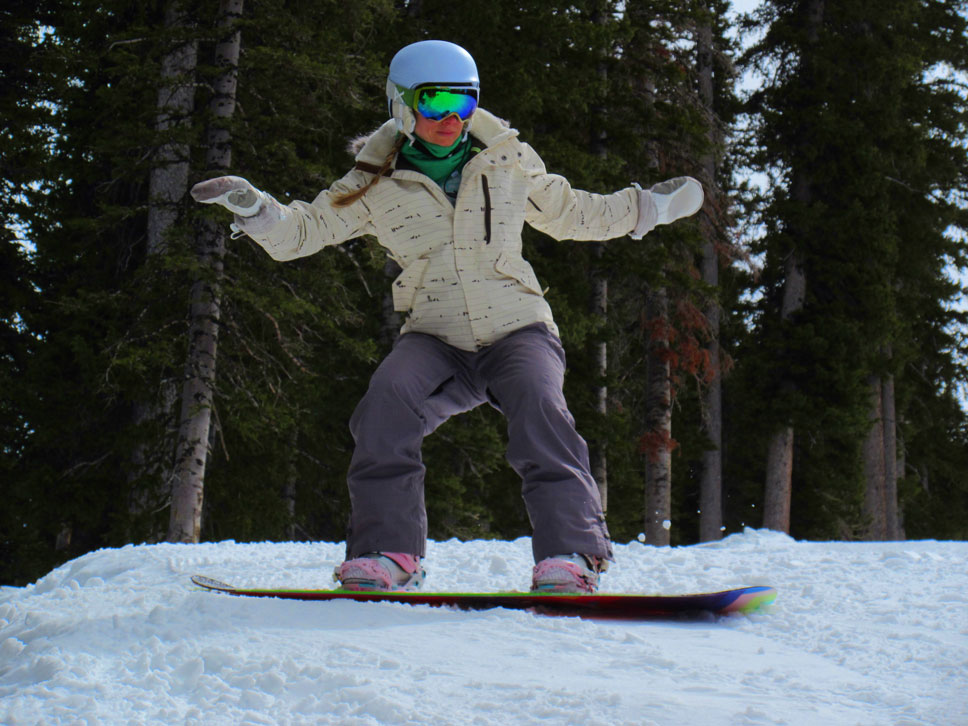
Smiles go with boarding even when it’s too cold to see them.
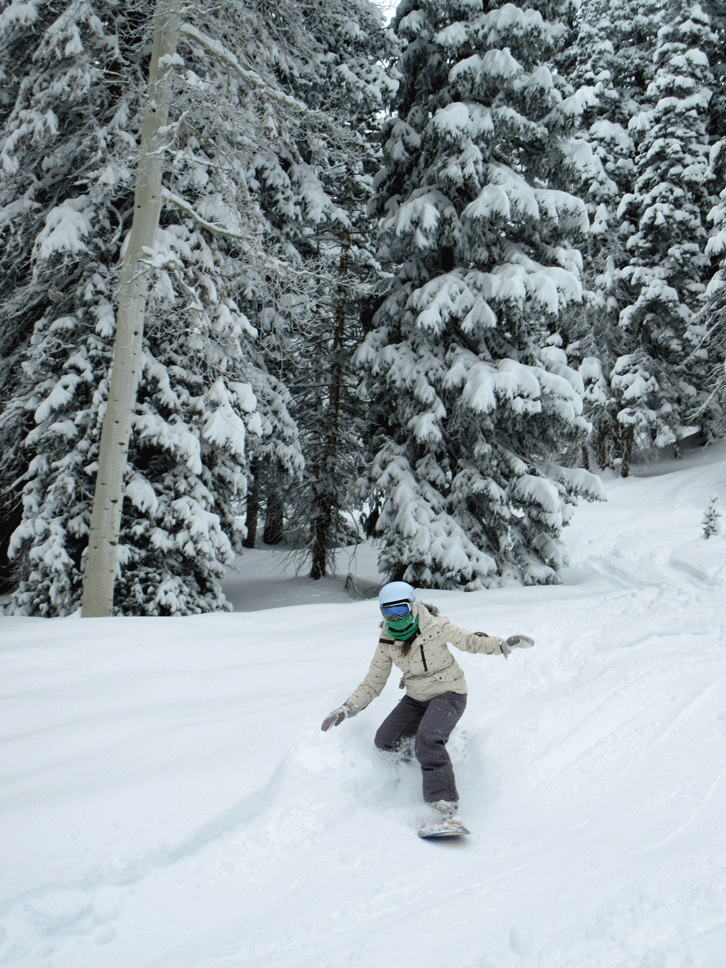
I was coming out of deep powder. That’s all I have to say about this awkward pose.
Jason and I went snowboarding exactly five times this season, our lowliest amount in years. We were ever ready to go but it’s a bit tricky to snowboard without snow. However, all was not lost. We did have a few good storms and Jason and I hit every single one of those. Like crazed kids at a carnival, we gorged ourselves on powder whenever it presented itself yet walked away from the season feeling rather unsatisfied.
The snow sculptures Brighton builds every year are always fun.
Strange things are met on the slopes, like my husband.
I was detectably moving here, I promise.
I hope our next winter deserves its accustomed loathing. You can say the climate hasn’t changed but it sure looks like it’s wearing a different outfit to me.
The beaches of Hawaii may be exceptional but the volcanoes are absolutely unique. There are only a few spots on Earth where you can walk on ground younger than you, the Big Island is one of those places. It’s got plenty of youthful dirt and more fiery births than Baby Story.
The waves at South Point were the biggest I’ve ever encountered.
The Big Island is home to five volcanoes. Only two of them, Kilauea and Mauna Loa, are currently active but that couple’s commotion more than makes up for the sleepiness of the others. Kilauea is the most active volcano in the world. It has been continually erupting since 1983 and spews somewhere between 300,000 and 1,000,000 cubic yards of lava out every day. Additionally, Kilauea’s Halema’uma’u Crater has the divine distinction of being home to the Hawaiian goddess of volcanoes, Pele. She knows how to pick quality real estate but her residence was a bit disordered during our stay.
South Point is not safe for swimming…or anything else really.
Although Hawai’i Volcanoes National Park, which contains all of Kilauea’s craters and rift zones, was more than a couple hours from our hotel, we decided it couldn’t be missed. We therefore planned a two-day excursion to the brink of that federally-funded inferno.
Halema’uma’u Crater was a blistering wound on the blackened landscape during the wee hours of the morning.
We took our time heading to Kilauea, pausing for a few distractions. South Point, the southernmost spot in the United States and a great place to witness the awesome power of the ocean, was our first diversion. There, the currents are so strong that if a vessel ventures out too far its next stop will be Antarctica. (Fishermen tie their boats to the shore when at South Point to prevent unplanned penguin parties.)
Kilauea Iki, a pit crater next to the main caldera of Kilauea, erupted in 1959. Its cracked basin looked more like a manmade mess than nature’s handiwork.
We also detoured to Punalu’u. This black sand beach, curiously, had lots of sightseers milling about on it like they didn’t know what to do with a beach. Incompetent tourists or just confusing colors?
Construction rubble or baby stone?
Later that afternoon, we arrived at Volcanoes…along with a whole bunch of other people. You see, a few days before our southbound journey, a series of small earthquakes blocked Halema’uma’u’s vent forcing lava usually hidden 100-200 feet below the crater floor to spout above ground in a breathtaking display. Nothing so dramatic had been seen at Halema’uma’u since 2008. While we were thrilled that we happened to be on the island at the right time to catch this magma magic, we weren’t the only ones eager to observe it. The locals were pouring in from all over the islands to witness Pele’s tantrum and congest my park experience.
These streaming rocks resulted from a 1972 eruption of Mauna Ulu.
After walking a mile that evening around the Sulphur Banks Trail, which showcases colorful minerals deposited by volcanic gases, we went to bed early and woke up at 3:30 AM so we could see Halema’uma’u’s glow show minus the crowds. It was spectacular but freezing, despite the 1500-degree magma.
Holei Sea Arch, hollowed from lava rock by the relentless ocean, epitomized the everlasting battle between fire and water.
Following an indispensable three-hour nap, we did several more hikes in Volcanoes. Our first was through Thurston Lave Tube, a 500-year-old cave formed by lava flow. Next, we hit Kilauea Iki Crater. Kilauea Iki, which is offset from the main Kilauea summit, exploded in 1959. We trekked four miles through the leftovers of that eruption. The scene looked more like a demolition zone than a piece of nature. Finally, we rambled a mile and a half to the Pu’u Loa Petroglyphs, the biggest petroglyph field in the state. Thousands of markings stud the frozen lava in this area. It was a fascinating glimpse into Hawaii’s past.
Jason “sensed” lava everywhere.
That was the end of our volcanic adventures. Pele was a mesmerizing yet violent hostess.
Next time, for the last part of our Big story, I will recount the highly engrossing tale of our journey through the skies and history of Hawaii. Plus, there will be seahorses.
Jason and I have traveled to a number of the Hawaiian Islands but we hadn’t journeyed to the mass from which that archipelago gets its name until our last big trip.
Snorkeling gear is about as sexy as it gets.
This spotted eagle ray didn’t seem intimidated by me but it wouldn’t get near Jason.
The island of Hawaii, commonly called the Big Island to avoid confusion, is, well, big. It’s larger than all of the other Hawaiian Islands put together and is a place of unexpected extremes. It boasts two peaks above 13,000 feet that accumulate snow but it also harbors scorching craters where the fire of new earth is continually smoldering.
This sub made catching some underwater action easy.
This shipwreck was real and this skeleton was real plastic.
Our first day on the island was all about relaxing or at least unwinding underwater. We snorkeled in King’s Pond, a pool carved out of natural lava rock that’s fed by subterranean channels and rises and sinks with the tide. King’s Pond holds 1.8 million gallons of water and 75 species of fish, including a spotted eagle ray. Its brackish alcoves weren’t the most pristine we’ve snorkeled in but its fish were abundant and they weren’t too shy around us human folk.
This broken mast had a massive moray as a tenant.
During our second day, we spent some time in Kailua Bay aboard a submarine. This vessel descended 111 feet below the surface to tour stretches of coral reef and skirt sunken ships. We saw countless fish, a huge eel, two shipwrecks, and even a shark while onboard. Not too bad for an undersea excursion that didn’t even require us to get our feet wet. Yup, it was basically scuba for the lazy man.
These ki’i surrounded the Hale o Keawe, the house that once held the bones of 23 chiefs.
Before heading back to our hotel at Hualalai, we detoured to Pu’uhonua o Honaunau, a national historic park. The ancient Hawaiians were governed by the kapu system. In this strict code of conduct, a commoner could be put to death, or become a human sacrifice, for breaking any of a long list of taboos. Their family might also share their fate. However, they had one hope for forgiveness. If they could make it to a pre-designated area of asylum before being caught or killed, all would be forgotten and they could return home in peace. Pu’uhonua o Honaunau served as such a place of refuge.
Konane was a strategy game played by the ancient Hawaiians.
Pu’uhonua o Honaunau’s grounds conveyed a lasting peace.
Although the kapu system disappeared nearly 200 years ago, the life-saving amnesty Honaunau once offered still permeated its quiet bay. With swaying coconut trees and lapping waves, this park was about as tranquil as it gets. We enjoyed the hush of the day slipping into twilight among its protective ki’i.
“Perfect” describes Hapuna perfectly.
Smiles, even crazy ones, were hard to contain on such a heavenly shoreline.
The following day we continued our therapeutic salting by visiting Hapuna Beach, which is consistently rated as one of the top ten beaches in the world. With fine golden sand that slopes gently into crystal waters, it’s no wonder. We boogie boarded for hours at Hapuna while sea turtles swam around our feet. Honestly, I highly doubt we will ever have a beach experience as nice as that again.
Hapuna was the stuff that sandy dreams are made of.
Boogie boarding is one of my favorite beach activities.
With visions of impeccable shores I leave you until next week’s sizzling recollections.






Recent Comments